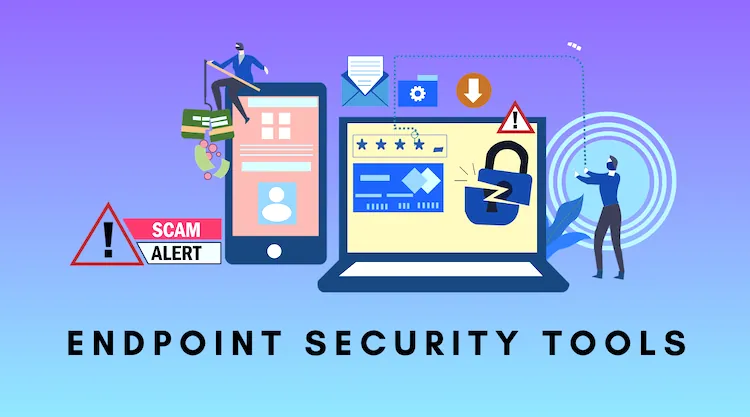
Endpoints are among the most targeted components of modern IT
environments. Laptops, desktops, mobile devices, and servers all
function as entry points into enterprise networks.
With remote work, cloud adoption, and BYOD policies becoming standard,
attackers increasingly focus on compromising endpoints as the first
step in larger attack campaigns.
Why Endpoint Security Is More Critical Than Ever
Traditional perimeter-based security assumes threats originate outside
the network. In reality, phishing, credential theft, and malware often
provide attackers with legitimate access via compromised endpoints.
Once an endpoint is compromised, attackers can move laterally,
escalate privileges, deploy malware, or exfiltrate sensitive data
without strong endpoint defenses.
Common Threats Targeting Endpoints
Endpoints face malware, ransomware, credential stealers, spyware,
and fileless attacks—many of which are designed to evade traditional
antivirus solutions.
Social engineering combined with malicious payloads remains one of
the most effective techniques for exploiting endpoint weaknesses.
Essential Endpoint Security Tools
Endpoint Protection Platforms (EPP)
EPP solutions provide baseline protection such as signature-based malware detection and exploit prevention. However, EPP alone is insufficient against advanced threats.
EPP solutions provide baseline protection such as signature-based malware detection and exploit prevention. However, EPP alone is insufficient against advanced threats.
Endpoint Detection and Response (EDR)
EDR focuses on continuous monitoring of endpoint activity, enabling detection, investigation, containment, and forensic analysis.
EDR focuses on continuous monitoring of endpoint activity, enabling detection, investigation, containment, and forensic analysis.
Extended Detection and Response (XDR)
XDR correlates telemetry across endpoints, networks, email, and cloud workloads, improving visibility into multi-stage attack chains.
XDR correlates telemetry across endpoints, networks, email, and cloud workloads, improving visibility into multi-stage attack chains.
Host-Based Firewalls & Application Control
These controls restrict unauthorized traffic and prevent execution of unapproved software, significantly reducing attack surface.
These controls restrict unauthorized traffic and prevent execution of unapproved software, significantly reducing attack surface.
Device Hardening & Configuration Management
Secure configurations and continuous configuration management prevent unnecessary services, reduce exposure, and control configuration drift.
Secure configurations and continuous configuration management prevent unnecessary services, reduce exposure, and control configuration drift.
Why Traditional Antivirus Is No Longer Enough
Signature-based antivirus struggles against zero-day exploits,
fileless malware, and living-off-the-land techniques that abuse
legitimate system tools.
Behavioral detection, telemetry correlation, and context-aware
analysis are now essential for effective endpoint protection.
Best Practices for Endpoint Security
Recommended Security Practices
- Deploy EDR or XDR alongside traditional EPP
- Enforce least-privilege access and strong identity controls
- Apply regular patching and vulnerability management
- Harden endpoints using secure baseline configurations
- Conduct continuous monitoring and threat hunting
- Train employees to recognize social engineering attacks
Conclusion
Endpoint security is a cornerstone of modern cybersecurity defense.
As endpoints remain primary attack entry points, organizations must
adopt advanced detection and response capabilities.
Investing in the right tools, configurations, and professional Security Assessments
significantly reduces attack impact and strengthens overall
security posture.
Strengthen Your Endpoint Security
Identify endpoint weaknesses, detect threats early, and improve response capabilities across your organization.
Request Endpoint Security Assessment