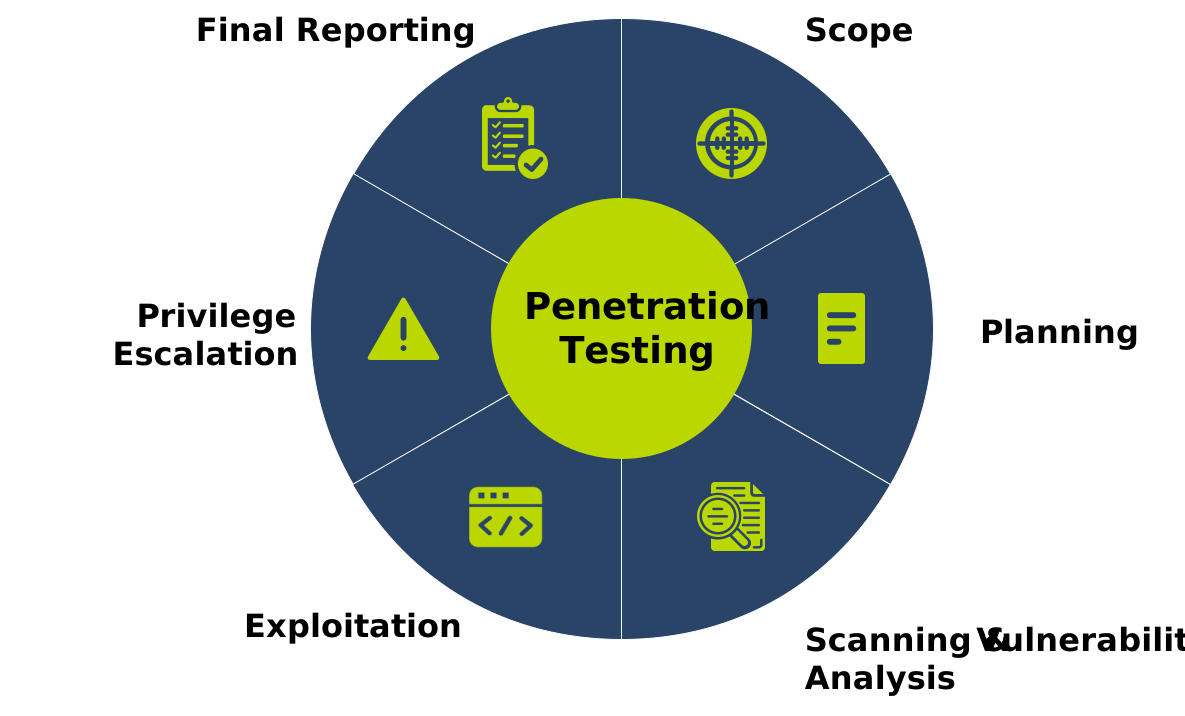
Penetration testing is one of the most effective ways to understand the real
security posture of an organization. Unlike automated scans or compliance
checklists, penetration testing simulates how real attackers compromise systems.
The objective is not just to find vulnerabilities, but to validate which
weaknesses are exploitable and what impact they would have in a real attack
scenario.
What Is Penetration Testing?
Penetration testing (pentesting) is an authorized security assessment where
skilled testers attempt to exploit vulnerabilities in systems, applications,
or networks under defined rules of engagement.
These rules ensure testing is legal, controlled, and focused on meaningful
security risk rather than disruption.
Why Penetration Testing Is Important
Automated tools cannot replicate human creativity. Penetration testing uncovers
logic flaws, chained vulnerabilities, and real attack paths that scanners miss.
Regular testing reduces breach risk, improves incident readiness, and helps
organizations meet regulatory and customer security expectations.
What Penetration Testing Reveals
Penetration tests uncover insecure configurations, weak authentication,
authorization flaws, exposed services, segmentation failures, and privilege
escalation paths.
They also demonstrate how multiple low-risk issues can combine into a
high-impact security incident.
Types of Penetration Testing
Network Penetration Testing
Identifies exposed services, misconfigurations, and lateral movement paths across internal and external networks.
Identifies exposed services, misconfigurations, and lateral movement paths across internal and external networks.
Web Application Penetration Testing
Evaluates authentication, access control, injection flaws, and business logic vulnerabilities in web applications.
Evaluates authentication, access control, injection flaws, and business logic vulnerabilities in web applications.
API Penetration Testing
Tests APIs for authentication weaknesses, excessive data exposure, rate limiting gaps, and logic flaws.
Tests APIs for authentication weaknesses, excessive data exposure, rate limiting gaps, and logic flaws.
Cloud Penetration Testing
Assesses IAM misconfigurations, exposed services, insecure storage, and privilege escalation in cloud environments.
Assesses IAM misconfigurations, exposed services, insecure storage, and privilege escalation in cloud environments.
Wireless & Endpoint Testing
Evaluates Wi-Fi networks, endpoints, and servers for weaknesses that enable initial compromise.
Evaluates Wi-Fi networks, endpoints, and servers for weaknesses that enable initial compromise.
Penetration Testing Approaches
Black-Box Testing
No prior knowledge is provided, simulating an external attacker with no internal access.
No prior knowledge is provided, simulating an external attacker with no internal access.
Grey-Box Testing
Limited information such as credentials or architecture details is shared to focus on realistic attack paths.
Limited information such as credentials or architecture details is shared to focus on realistic attack paths.
White-Box Testing
Full access to documentation and source code enables deep security analysis and comprehensive coverage.
Full access to documentation and source code enables deep security analysis and comprehensive coverage.
Penetration Testing vs Vulnerability Scanning
Vulnerability scanning identifies potential weaknesses automatically,
while penetration testing validates real-world exploitability and impact.
Scanners assist security—but they cannot replace manual testing.
Business Benefits of Penetration Testing
Organizational Benefits
- Prioritization of security investments
- Reduced likelihood of real-world breaches
- Improved regulatory and compliance posture
- Stronger security awareness across teams
How Often Should Penetration Testing Be Done?
Penetration testing should be conducted regularly and after major changes
such as new releases, infrastructure updates, or cloud migrations.
Security is an ongoing process—not a one-time event.
Conclusion
Penetration testing provides a realistic view of organizational security.
By simulating real attacks through professional VAPT Services, it reveals vulnerabilities that truly
matter.
Looking for a Penetration Test?
Identify real risks with expert-led, scenario-driven security testing.
Request Penetration Testing