

In the digital era, convenience often dictates our choices. However, this convenience also introduces vector surfaces for highly coordinated financial attacks. In this digital forensics case study, the HackVitraSec Solutions incident response team dissects a banking scam that targeted an individual looking to book an appointment with a consulting doctor.
Through social engineering over a WhatsApp chat channel, the victim was prompted to download a proprietary "Doctor Appointment Android Package (APK)" file. This apparently simple action bypassed secure distribution portals and led to a systematic, unauthorized exfiltration of ₹5,00,000 from the victim's primary bank account in under two hours.
Case Overview
To assist security professionals and audit teams, we compiled the core details of this security incident below:
Attack Timeline
Understanding the precise temporal steps of this scam demonstrates how quickly vulnerability exploitation converts into financial theft:
Step 1: Searching for a Doctor
The victim searches for a renowned local specialist online. Finding a fraudulent contact listing pointing directly to the scammers, they initiate communication to book a routine medical check-up.
Step 2: Appointment Booking
The fraudster, pretending to represent the medical clinic, converses via WhatsApp. They claim that appointment schedules are full but offer booking priority if completed via their exclusive app.
Step 3: APK Installation
The fraudster sends an APK package (named e.g. DoctorAppointment.apk) via WhatsApp. They instruct the victim to allow "Unknown Sources" inside Android Settings to run the application.
Step 4: Test Transaction
The app prompts a ₹10 registration fee. The victim inputs their active banking details. This dummy transaction acts as an credentials harvest channel while verifying connectivity to payment gateways.
Step 5: Unauthorized Fund Transfers
With database entries and background SMS listeners fully active, the scammers trigger multiple transactions, intercepting and masking OTP confirmation messages. ₹5,00,000 is siphoned off in less than two hours.
Digital Forensics Investigation
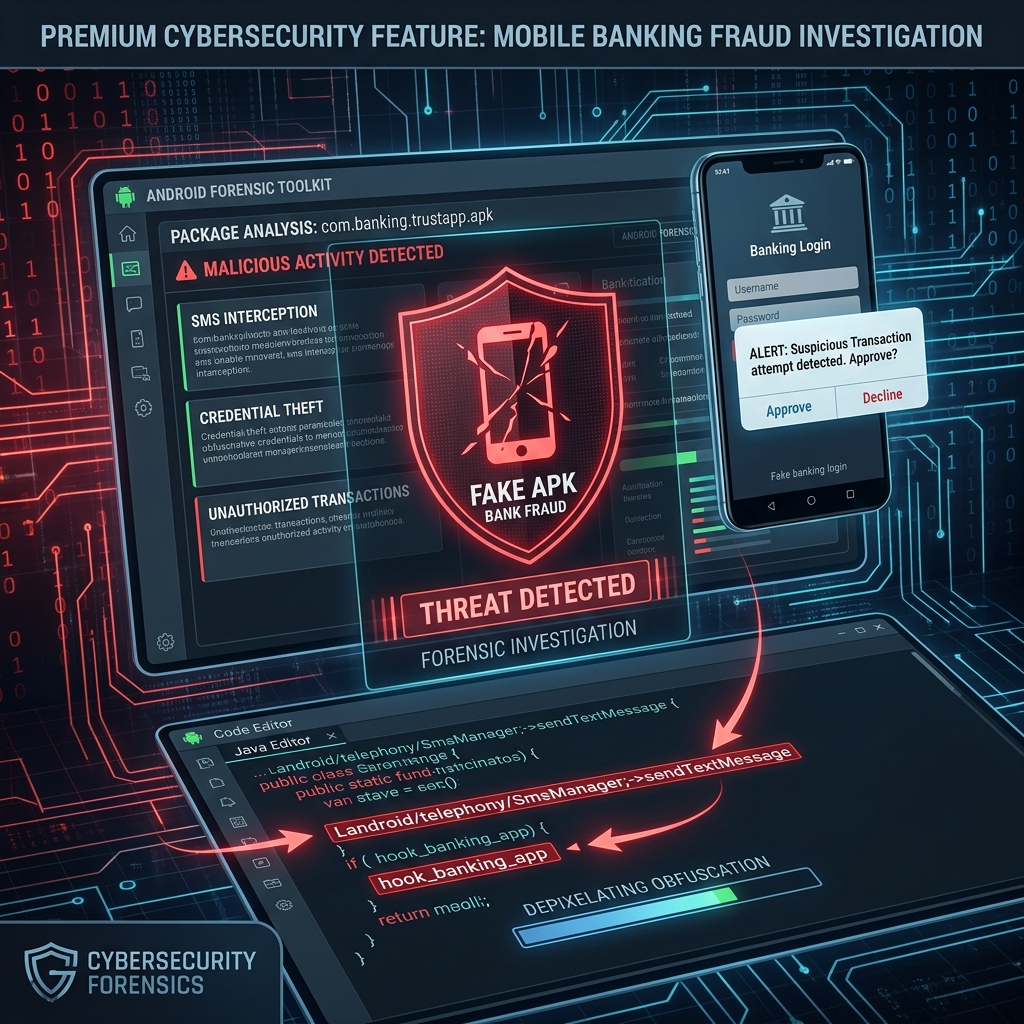
Our digital forensics team reverse-engineered the retrieved application package inside an isolated laboratory container. Below are the key scientific investigation findings:
Installing applications outside of official stores (side-loading) completely strips the host system of its built-in sandbox security checks, rendering the device highly vulnerable to deep kernel malware injections.
APK from Untrusted Source
The application bypasses Google Play Protect. Dynamic signature analysis verified that the package did not originate from any registered healthcare provider.
SMS Permissions Enabled
During execution, the application forcefully requested read, receive, and send permissions for SMS messages (READ_SMS & RECEIVE_SMS).
Suspicious Permission Abuse
The APK requested device admin accessibility privileges, preventing users from closing the app or revoking security permissions manually.
Notification Interception
A background listener captured incoming SMS events, matching numeric sequences, and forwarded them immediately to a remote C2 command server.
Transaction Patterns
The remote servers mapped the captured bank account details and triggered multiple automated clearing house transfers consecutively.
Our telemetry verified that the malware utilized a lightweight SMS grabber module. The script intercepted target numbers belonging to major regional banks, instantly deleting the SMS locally so the victim never noticed the transaction alerts.
Root Cause Analysis
To evaluate why this breach was successful, we conducted a root cause analysis to identify the primary security failures:
Outside Official Ecosystem
Installing software directly via chat channels bypasses system validation and sandboxing features present in mainstream app stores.
Excessive Permissions
Granting access to global accessibility services and SMS features gave the malware full read/write visibility over transaction flows.
Lack of Authenticity
The victim lacked toolsets or training to verify the digital signature, hash value, or authenticity of the received application package.
Untrusted Communication
Conducting financial and booking operations over unverified chat portals exposes users to severe spoofing risks.
Delayed Fraud Detection
The host device had no active malware scanners installed, allowing the background data-mining threads to run completely unchecked.
Security Impact
The implications of mobile APK infections span beyond immediate financial theft. Here is the operational security impact:
Unauthorized Application Access
Scammers achieved remote execution on the host device, granting complete dashboard visibility over installed personal profiles.
Banking SMS Exposure
All historical and incoming communications (including private bank statements and personal conversations) were compromised.
OTP Interception Risk
Because the grabber dynamically synced values to C2 nodes, multi-factor security barriers were rendered completely useless.
Financial Fraud
Unauthorized routing of ₹5,00,000 occurred without manual verification alerts prompting the victim.
Incident Response Complexity
Identifying obfuscated system processes, trace registry keys, and root kits on hijacked systems requires highly specialized lab tools.
Lessons Learned
This incident highlights the vital need for proactive mobile security practices. Expand the cards below to review our forensic security recommendations:
How HackVitraSec Solutions Can Help
HackVitraSec Solutions provides advanced, industry-certified digital forensics, mobile device auditing, and proactive security consulting services to safeguard both individuals and global enterprises.
Digital Forensics Investigation
Tracing hacker footprint, recovering log telemetry, extracting system registry variables, and documenting security incidents.
Android & Mobile Analysis
Deep-dive malware reverse engineering, testing APK architectures, and dynamic app-layer sandboxing.
Incident Response
Rapid post-breach mitigation, threat hunting, blocking C2 communications, and asset containment.
Malware Investigation
Identifying Trojan payloads, reverse-engineering malware strings, and creating custom defense signatures.
VAPT Services
Full-scale penetration testing to locate and close network, system, and application-level security gaps.
Mobile App Security Testing
Dynamic and static code audits (DAST/SAST) focused on safeguarding mobile APIs and encryption layers.
Web Application Security
Securing business sites, API gateways, and web portal database models against OWASP Top 10 vulnerabilities.
API Security Assessment
Vulnerability mapping on business endpoint paths, preventing broken object-level authorization (BOLA).
Attack Surface Management
Proactive tracking and mapping of internet-facing digital assets to detect exposed server dashboards.
Security Awareness Training
Interactive training modules simulating social engineering attacks, email phishing, and side-loading risks.
Secure App Development
Building secure, production-grade custom web platforms and mobile apps built with strict zero-trust standards.
Security Consulting
Guiding organizations to align operational protocols with international compliance standards (ISO 27001/SOC 2).
Related Services
Frequently Asked Questions (FAQ)
Explore general insights and technical questions relating to malicious Android packages and banking security: